top of page

April Showers Bring...(Part 3)

  • Ian Thompson
  • 2 days ago
  • 8 min read

In late February, we conducted a controlled burn on 150 acres of Nan Awaya Farm. We've done small burns here before, but this was an opportunity to see what this ancient practice would do for our efforts to increase the native vibrancy of this land on a bigger scale. This post follows up on our commitment to share how the land responds to the burn over the course of the growing season. Through the images and words below, we hope to share some more native stories and some new paths of learning about managing land.

Native landscapes, especially grasslands, are vibrant and constantly changing places. "Earthly paradise" continues to describe the landscapes of the farm this spring.  As they come back from the burn, these landscapes continue to be electric green and open, with few ticks, few thorn vines, and lots of deer. It's easy to see why the Choctaw ancestors and other Indigenous communities all over the world took care of their land by doing burns...
Native landscapes, especially grasslands, are vibrant and constantly changing places. "Earthly paradise" continues to describe the landscapes of the farm this spring. As they come back from the burn, these landscapes continue to be electric green and open, with few ticks, few thorn vines, and lots of deer. It's easy to see why the Choctaw ancestors and other Indigenous communities all over the world took care of their land by doing burns...

Nan Awaya Farm has over 200 species of remnant, native, non-woody plants that have existed on this land since time immemorial. Many of them have adapted to thousands of years of fire in ways that allow them to become more vigorous and/or spread across a landscape that has been recently burned.  As mentioned in our previous post, Old Plainsman is one of the native prairie plants that is thriving here after the burn.  This spring, little native bees have been busy on its flowers, the first of which, are now going to seed.  Over the coming weeks, we'll collect seeds and plant them on some of the farm's landscapes where Old Plainsman is not currently growing. Hopefully, there will be even more Old Plainsman plants after the next burn... and more native bees.
Nan Awaya Farm has over 200 species of remnant, native, non-woody plants that have existed on this land since time immemorial. Many of them have adapted to thousands of years of fire in ways that allow them to become more vigorous and/or spread across a landscape that has been recently burned. As mentioned in our previous post, Old Plainsman is one of the native prairie plants that is thriving here after the burn. This spring, little native bees have been busy on its flowers, the first of which, are now going to seed. Over the coming weeks, we'll collect seeds and plant them on some of the farm's landscapes where Old Plainsman is not currently growing. Hopefully, there will be even more Old Plainsman plants after the next burn... and more native bees.
Although many native plants remain, some of this farm's landscapes have been damaged by past years of over grazing.  While we have a lot of native species, some of the important ones that are tasty to cows, are rare. A few plants that should be here are gone entirely. We are actively hand-planting them back in thousands of patches.  This burn removed thatch and made planting much easier. Here is a patch of young Indian grass (Oklahoma's state grass), that I planted a month ago, coming up well.  We collected this seed last fall from a good-sized roadside prairie remnant located about 8 miles from here.
Although many native plants remain, some of this farm's landscapes have been damaged by past years of over grazing. While we have a lot of native species, some of the important ones that are tasty to cows, are rare. A few plants that should be here are gone entirely. We are actively hand-planting them back in thousands of patches. This burn removed thatch and made planting much easier. Here is a patch of young Indian grass (Oklahoma's state grass), that I planted a month ago, coming up well. We collected this seed last fall from a good-sized roadside prairie remnant located about 8 miles from here.
Young prairie grass plants can stay tiny, like just a couple of inches tall, for years until the right conditions come along.  Then, they grow prodigiously to become dominant plants. Clearing old vegetation and blackening the ground, fire makes for those right conditions.  Here is some Indian grass planted two or tree years ago (the blueish-green plant at the center).  It's about a foot tall and a foot wide.  In a couple more years, it will be 3ft tall and 4ft wide, pushing out the ragweed and goat weed that surround it now, protecting the soil from drought, providing habitat for grassland birds, and being a favorite perennial food source for our bison.
Young prairie grass plants can stay tiny, like just a couple of inches tall, for years until the right conditions come along. Then, they grow prodigiously to become dominant plants. Clearing old vegetation and blackening the ground, fire makes for those right conditions. Here is some Indian grass planted two or tree years ago (the blueish-green plant at the center). It's about a foot tall and a foot wide. In a couple more years, it will be 3ft tall and 4ft wide, pushing out the ragweed and goat weed that surround it now, protecting the soil from drought, providing habitat for grassland birds, and being a favorite perennial food source for our bison.

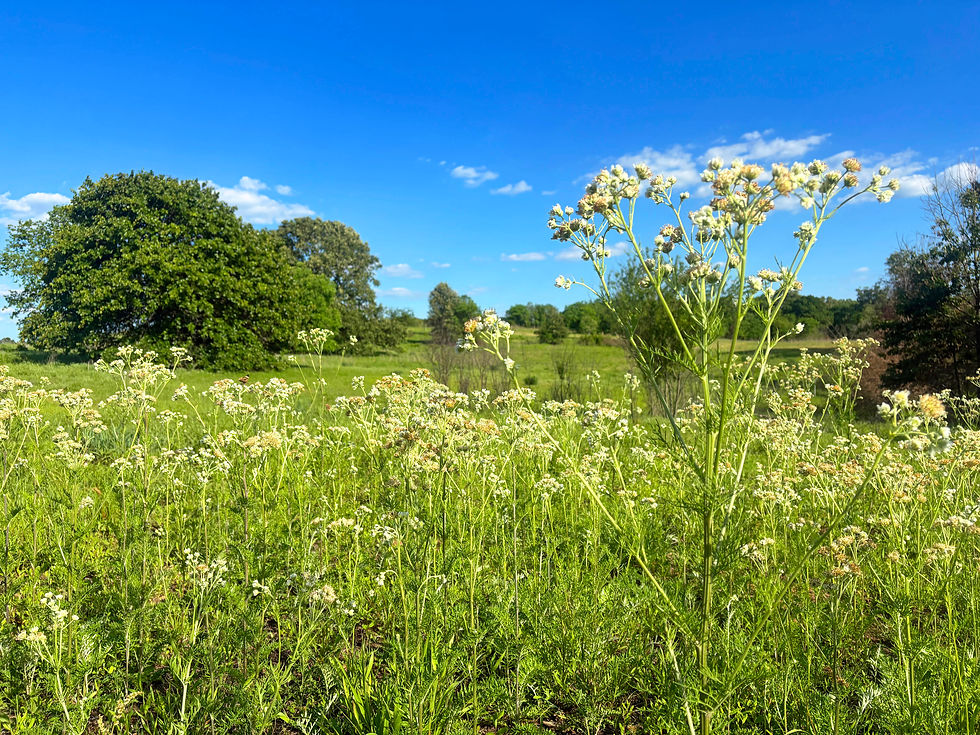
As a man, I have absolutely no interest in garden flowers.  Zero. I used to feel the same way about wildflowers too, until I realized several things about them.  First, these native plants literally are the native landscape.  The plant pictured here is Prairie Parsley. Its range extends from the Black Belt Prairie of Alabama into east-central Nebraska.  When I see it, I think about all of the vibrant landscapes this plant  has been a part of in the American heartland over the past 15,000 years. Most of them have since been plowed under and will never be seen again. Yet, the Prairie Parsley growing here on Nan Awaya Farm today, is a living  connection to every landscape that this plant has grown on, present and past. I think about the beautiful, unexplainable, and historically important scenes from Native American history that have happened within sight of this plant. I think about Chief Tvshkalusa (who lead Choctaw ancestors in a battle against Hernando De Soto's army in 1540), picking its seeds as a kid and what cultural lore he knew about Prairie Parsley that I don't (Like even its name in the Choctaw language). I think about the ways, known and currently not known to science, that this plant supports the other native life around it and what knowledge it could hold that would be of relevance to humanity enjoying a livable future on this planet.
As a man, I have absolutely no interest in garden flowers. Zero. I used to feel the same way about wildflowers too, until I realized several things about them. First, these native plants literally are the native landscape. The plant pictured here is Prairie Parsley. Its range extends from the Black Belt Prairie of Alabama into east-central Nebraska. When I see it, I think about all of the vibrant landscapes this plant has been a part of in the American heartland over the past 15,000 years. Most of them have since been plowed under and will never be seen again. Yet, the Prairie Parsley growing here on Nan Awaya Farm today, is a living connection to every landscape that this plant has grown on, present and past. I think about the beautiful, unexplainable, and historically important scenes from Native American history that have happened within sight of this plant. I think about Chief Tvshkalusa (who lead Choctaw ancestors in a battle against Hernando De Soto's army in 1540), picking its seeds as a kid and what cultural lore he knew about Prairie Parsley that I don't (Like even its name in the Choctaw language). I think about the ways, known and currently not known to science, that this plant supports the other native life around it and what knowledge it could hold that would be of relevance to humanity enjoying a livable future on this planet.

Keeping in mind that there's a lot more depth to these plants than just pretty flowers (pun intended), I'm going to show you some of the native blooms that are out on the farm right now.  Unless otherwise noted, all of these are remnant to this farm's landscapes, like this Four Point Evening Primrose (Oenothera rhombipetala). This species lives on sandy, tallgrass prairie remnants stretching from central Texas to North Dakota. - It's warm and muggy on the farm this weekend; can we go visit its North Dakota relatives?
Keeping in mind that there's a lot more depth to these plants than just pretty flowers (pun intended), I'm going to show you some of the native blooms that are out on the farm right now. Unless otherwise noted, all of these are remnant to this farm's landscapes, like this Four Point Evening Primrose (Oenothera rhombipetala). This species lives on sandy, tallgrass prairie remnants stretching from central Texas to North Dakota. - It's warm and muggy on the farm this weekend; can we go visit its North Dakota relatives?

Large Clammyweed (Polanisia erosia) has some of the most unusual flowers.  To me, they look a lot like the head of a bull moose.  The majority of this plant's native range is in east Texas, and it hasn't been recorded for our county, at least on BONAP. It likes fire.
Large Clammyweed (Polanisia erosia) has some of the most unusual flowers. To me, they look a lot like the head of a bull moose. The majority of this plant's native range is in east Texas, and it hasn't been recorded for our county, at least on BONAP. It likes fire.

Prairie Larkshur (Delphinium virescens) is a deadly native beauty.  Native to the Choctaw homeland and across the Great Plains, all parts of this plant are toxic to mammals, but not to insect pollinators.
Prairie Larkshur (Delphinium virescens) is a deadly native beauty. Native to the Choctaw homeland and across the Great Plains, all parts of this plant are toxic to mammals, but not to insect pollinators.
Erect Dayflower (Commelina erecta) is another one that likes fire.
Texas Dandelion (Pyrrhopappus pauciflorus) is not a true dandelion.  Adapted to heat and to dry soils, it's flowers open in the morning and close for the heat of the day (smart!).  Texas dandelion, a favorite of small-size pollinators like the one you see here, has become more abundant after the fire.
Texas Dandelion (Pyrrhopappus pauciflorus) is not a true dandelion. Adapted to heat and to dry soils, it's flowers open in the morning and close for the heat of the day (smart!). Texas dandelion, a favorite of small-size pollinators like the one you see here, has become more abundant after the fire.

Ditto the Texas vervain (Verbena halei). This southern plant grows from the Florida peninsula to west Texas, and not much farther north from where we are.
On the other hand, Spiderwort (Tradescantia) seems to be indifferent to the fire.  There's about as much growing here right now as any year.
On the other hand, Spiderwort (Tradescantia) seems to be indifferent to the fire. There's about as much growing here right now as any year.

Indian Paintbrush (Castilleja indivisa) also doesn't seem to have been helped or harmed by the fire.  We just have a few patches of this hemiparasitic plant here.  We would love more.  This one can be a bit frustrating, because you see it blanketing the ground in red on landscapes that are a lot more damaged than the ones on the farm. At least there's still a lot of this plant around.
Indian Paintbrush (Castilleja indivisa) also doesn't seem to have been helped or harmed by the fire. We just have a few patches of this hemiparasitic plant here. We would love more. This one can be a bit frustrating, because you see it blanketing the ground in red on landscapes that are a lot more damaged than the ones on the farm. At least there's still a lot of this plant around.

Other plants did not fair quite so well in the fire, especially the wildflowers that bloom in early spring, like this Venus' Looking Glass (Triodanis perfoliata).  Usually, a fairly common plant for us, the only ones that came out on Nan Awaya Farm this year were the ones that grew outside of the burn lines and the very late bloomers.  This is an example of why you wouldn't want to burn an entire habitat in the same season, year after year.
Other plants did not fair quite so well in the fire, especially the wildflowers that bloom in early spring, like this Venus' Looking Glass (Triodanis perfoliata). Usually, a fairly common plant for us, the only ones that came out on Nan Awaya Farm this year were the ones that grew outside of the burn lines and the very late bloomers. This is an example of why you wouldn't want to burn an entire habitat in the same season, year after year.

For years, we've been trying to figure out how to grow more milkweed on this land to support the monarch butterfly.  The fire doubled the number of stalks we have for all four of our remnant milkweed species.  Even so, I hadn't seen a single monarch caterpillar this spring. Until yesterday!
For years, we've been trying to figure out how to grow more milkweed on this land to support the monarch butterfly. The fire doubled the number of stalks we have for all four of our remnant milkweed species. Even so, I hadn't seen a single monarch caterpillar this spring. Until yesterday!
Prairie Petunia (Ruellia humilis) is beauty that's easy to miss. From south Texas to Lake Michigan, it grows in the understory of native grasslands. Each flower only lasts for a day.  Turns out, it really loves fire, especially in the clumpy ground cover dominated by Little Bluestem.
Prairie Petunia (Ruellia humilis) is beauty that's easy to miss. From south Texas to Lake Michigan, it grows in the understory of native grasslands. Each flower only lasts for a day. Turns out, it really loves fire, especially in the clumpy ground cover dominated by Little Bluestem.
Pencil Flower (Stylosanthes biflora) is another understory plant that you won't see while whizzing by in a car. You have to go out in the prairie and look closely. It likes fire.
Sensitive Brier (Mimosa nuttalli), found across Oklahoma, Kansas, Missouri, and Arkansas, is one of the neatest plants around.  Its leaves close like a Venus flytrap; it's flowers feed pollinators; it's foliage feeds grazing and browsing animals that aren't afraid of the little prickles, and it's roots team up with bacteria to put nitrogen into the soil.
Sensitive Brier (Mimosa nuttalli), found across Oklahoma, Kansas, Missouri, and Arkansas, is one of the neatest plants around. Its leaves close like a Venus flytrap; it's flowers feed pollinators; it's foliage feeds grazing and browsing animals that aren't afraid of the little prickles, and it's roots team up with bacteria to put nitrogen into the soil.


In the spring, remnant prairies in our area are full of Barbara's Buttons (Marshallia caespitosa).  This includes the 50ft-long 10-ft wide remnant in the ditch just up the road from us. Unfortunately, Barbara's Buttons has been completely extirpated from this farm's landscapes.  We've been trying for years to reintroduce it.  We had our first plant come up last year. This spring, we had six plants come up and bloom, but something (probably rabbits) ate all of the flowers before they could make seed.
In the spring, remnant prairies in our area are full of Barbara's Buttons (Marshallia caespitosa). This includes the 50ft-long 10-ft wide remnant in the ditch just up the road from us. Unfortunately, Barbara's Buttons has been completely extirpated from this farm's landscapes. We've been trying for years to reintroduce it. We had our first plant come up last year. This spring, we had six plants come up and bloom, but something (probably rabbits) ate all of the flowers before they could make seed.

Everything we've looked at so far is in the farm's uplands.  The seep, comprising our lowlands, is the highest quality remnant on the place. It is thriving after the burn too.  We continue to see palatable, grass-like native plants expanding at the expense of wire grass. In the foreground is our single remnant patch of Wild White Indigo (Baptisia alba) on the farm, 4-ft tall and slowly spreading.
Everything we've looked at so far is in the farm's uplands. The seep, comprising our lowlands, is the highest quality remnant on the place. It is thriving after the burn too. We continue to see palatable, grass-like native plants expanding at the expense of wire grass. In the foreground is our single remnant patch of Wild White Indigo (Baptisia alba) on the farm, 4-ft tall and slowly spreading.

Right now, the seep is alive with a plant that bears a crazy name - Foxglove Beardtongue (Pestemon digitalis). The pollinators, like this bumble bee, don't care about the name.
The seep is full of turtles right now, too, including this one, which is 10-inches long.  I don't know it's species name, yet. Amy thinks we should name it "Harry".
The seep is full of turtles right now, too, including this one, which is 10-inches long. I don't know it's species name, yet. Amy thinks we should name it "Harry".

Back to the uplands - the Queen's Delight (Stillingia sylvatica) is in bloom, with its unusual, green flowers.
Lanceleaf Blanket Flower (Gaillardia aestivalis) is a close relative of Oklahoma's famous Indian Blanket.  This farm had two small remnant populations of Lanceleaf growing in marginal areas where the previous owners' cattle didn't graze as heavily.  As of this morning, none of them are up.  We could have easily lost this native species from this landscape. However, for a couple of years, we collected some of the seeds from the plants growing on the margins and planted them in other pastures. It's blooming in multiple pastures as I type. One of them has 9 patches growing in a 50ft by 50ft area, including the plant that was visited by this bumble bee.
Lanceleaf Blanket Flower (Gaillardia aestivalis) is a close relative of Oklahoma's famous Indian Blanket. This farm had two small remnant populations of Lanceleaf growing in marginal areas where the previous owners' cattle didn't graze as heavily. As of this morning, none of them are up. We could have easily lost this native species from this landscape. However, for a couple of years, we collected some of the seeds from the plants growing on the margins and planted them in other pastures. It's blooming in multiple pastures as I type. One of them has 9 patches growing in a 50ft by 50ft area, including the plant that was visited by this bumble bee.
Yarrow, (Achillea millefolium), aka Choctaw "Nosebleed Medicine", loves fire. It grows in just about every county of the contiguous United States.
There are other native flowers in bloom on the farm right now. Dozens of more stories remain to be told about each of the plants that have been featured in this post. A post can't go on forever, though, even if its topic is practically infinite.  I'll end this native plant tour with one of our first Black-Eyed Susans (Rudbeckia hirta) of the year. The yellow blooms of this plant will be all over the uplands of the farm during the heat of summer.
There are other native flowers in bloom on the farm right now. Dozens of more stories remain to be told about each of the plants that have been featured in this post. A post can't go on forever, though, even if its topic is practically infinite. I'll end this native plant tour with one of our first Black-Eyed Susans (Rudbeckia hirta) of the year. The yellow blooms of this plant will be all over the uplands of the farm during the heat of summer.

Native plants are not the only ones that like fire. Chinese Bush Clover (Serecia lespediza) was imported into the US in the 1930s and planted across the Southeast to help combat erosion.  Grazing animals don't eat, it once it's mature.  One Serecia plant can make thousands of seeds, and they stay viable in the ground for decades. This legume does not improve available soil nitrogen. Instead, it changes the soil life in a way that gives this plant an advantage over natives.  Serecia is capable of invading and destroying prairie remnants.  We have a few patches of it on the Farm, where previous managers used to feed hay.  I've been pulling it out every year.  This is ineffective.  Serecia's coverage has increased about 5-fold while I've been pulling it.  This plant loves fire, and the burn has really made it come out.  That can actually be an advantage.  I HATE to spray, but that is the only known way to stop Serecia. This spring, I've spot-sprayed every single plant I can find (with triclopyr).  That hasn't killed all of it, but it has weekend it.  I'll hit it again (with metasulphuron-mthyl), later this summer when it blooms and hopefully start to see its coverage begin to permanently shrink.
Native plants are not the only ones that like fire. Chinese Bush Clover (Serecia lespediza) was imported into the US in the 1930s and planted across the Southeast to help combat erosion. Grazing animals don't eat, it once it's mature. One Serecia plant can make thousands of seeds, and they stay viable in the ground for decades. This legume does not improve available soil nitrogen. Instead, it changes the soil life in a way that gives this plant an advantage over natives. Serecia is capable of invading and destroying prairie remnants. We have a few patches of it on the Farm, where previous managers used to feed hay. I've been pulling it out every year. This is ineffective. Serecia's coverage has increased about 5-fold while I've been pulling it. This plant loves fire, and the burn has really made it come out. That can actually be an advantage. I HATE to spray, but that is the only known way to stop Serecia. This spring, I've spot-sprayed every single plant I can find (with triclopyr). That hasn't killed all of it, but it has weekend it. I'll hit it again (with metasulphuron-mthyl), later this summer when it blooms and hopefully start to see its coverage begin to permanently shrink.
This spring, we've been paying a lot more attention to the native birds on the farm.  The Merlin app., created by the Cornell Lab of Ornithology turns your phone into an expert birder.  You can let the app run while your outside, and it's like having the birder sitting there with you, identifying all of the calls and telling you some of the fascinating stories of the different species. This spring, Merlin has helped us to casually identify more than 70 native bird species on the farm, including a number of native grassland birds that are in rapid decline across the country. Pictured are Brown-Headed Cowbirds sitting on the line that feeds into our house. Their songs sound like flowing water.
This spring, we've been paying a lot more attention to the native birds on the farm. The Merlin app., created by the Cornell Lab of Ornithology turns your phone into an expert birder. You can let the app run while your outside, and it's like having the birder sitting there with you, identifying all of the calls and telling you some of the fascinating stories of the different species. This spring, Merlin has helped us to casually identify more than 70 native bird species on the farm, including a number of native grassland birds that are in rapid decline across the country. Pictured are Brown-Headed Cowbirds sitting on the line that feeds into our house. Their songs sound like flowing water.


In upcoming posts, we'll keep sharing the stories within the story as this land continues its response to the burn.


1 Comment


sdsilver72
sdsilver72
15 hours ago

Oh How wonderful to get all these photos and information about the wildflowers in the pastures! Thank you for sharing !😍


Like
About Us

Amy and Ian Thompson are a couple with a passion for reawakening Choctaw traditional knowledge in a way that can improve quality of life in today's world.  To hear an in-depth conversation with them about Nan Awaya Farm, please visit Native ChocTalk.


Join our mailing list

  • White Facebook Icon

© 2023 by Going Places. Proudly created with Wix.com

bottom of page