Hunting Deer with Stones
Updated: Feb 28

Over the past couple of years, we've been working to learn more about traditional hunting. Most language-learners will tell you that if you want to speak Choctaw fluently, books can help, but immersion is the only way to get there. It's the same thing with other parts of Indigenous culture. The best learning often comes when you go out there and try to do the same things the ancestors did yourself. A lot of the things they did weren't easy. Trying to follow their footsteps can be humbling, but even if you stumble, the first-hand learning experiences connect you with land and heritage in a way that few other things can. This post shares some of the connections and some of the lessons learned from a second season of trying to hunt the way that the Choctaw ancestors did.
The weapon - When I was about 20 years old, I'd been making bows for 5 years. I decided to take on what was the ultimate project for me at the time, making a big, strong, Choctaw-style bow to hunt with. It would be more powerful than the other bows I had made before. While shaping this bow, I had it on a tillering board at full draw when the string bent the nail holding it and slipped off. One of the bow's limb tips smacked my finger held in the air. Blood spray hit the ground. When I cleaned the finger up, there was no cut. Apparently, the unleashed power stored in the bow had been enough to drive the blood straight through the pores of my skin. The finished bow pulled about 70lbs. When I shot it, it was kind of startling to see how much force it sent the arrows with.
Back in those days, I used to practice my woods skill by stalking deer on public land in Missouri. Sometimes, I used to get pretty close to an animal. Once, I was so close that I had to gently startle the deer because I was afraid it was going to walk right onto me and start kicking. I figured I'd take my new Choctaw bow with me stalking one day and that would be my first deer hunt. Just about then, an ill-fated day in the woods got me 600 seed tick bites, a serious case of Lyme disease, and doctor's orders to never eat deer meat again.
Even if I couldn't hunt with it, I was still connected with my new bow. When I went to school in Albuquerque, it came with me. There was nowhere else to keep it but under my mattress. I used to go out on West Mesa, where no one was around and use it to launch arrows as far as I could over the flat sands. There are few sensations in the traditional arts as cool as using an archery set that you've made to launch an arrow streaking up into the sky faster and higher than seems physically possible. One day, I was doing that when a pretty bizarre thing happened. I saw an SUV driving by on a flat, dirt road a couple hundred yards from me. Paying it no mind, I kept shooting until I heard an emergency vehicle siren and looked back at the road. There was that SUV, now resting flat on its rooftop. How on earth did that happen on that straight, flat road, and how on earth did it not make enough noise for me to hear? The passengers were OK; eventually the vehicle left on the back of a tow truck. The event seemed surreal, but it was as real as the bow in my hand.

I've made a lot of other bows through the years, but I always held onto this one. One year, Choctaw Nation worked with artist John Gooden to create the iconic Tvshka Humma (Red Warrior) bronze sculpture at the Tribal Capitol. When a big, powerful Choctaw bow was needed as a model, mine was handy. It posed for the sculpture at full draw. With a little artistic license, that's it in the Red Warrior's hand, where it will probably remain for centuries. A duplicate of the sculpture now also stands in front of the Cultural Center. The Choctaw Veterans flag incorporates the likeness of the Red Warrior statue; so in a way the bow's likeness is on it as well. Of course, it's not that my old bow is special, it's that what it represents - the heritage of Choctaw archery - is special.
Last year, I was unexpectedly cleared to eat deer meat after being Lyme-free for more than 15 years. In a few months, I made a Choctaw archery set from materials here on the farm and used a stone-tipped arrow to harvest a deer a few hundred steps from our house (see post). Finally getting to participate in the traditional deer hunt stands out among my life experiences, but afterwards, there was still a lot more left to do. For one, with the mountain lions and other deer predators are functionally gone from this landscape, we need to try to harvest a few deer every year to keep the population in healthy balance. For another thing, let's be honest. Hunting between work hours through one deer season, I'd only gained about as much bow-in-hand hunting experience as any Choctaw youth of 300 years ago would have amassed in his first couple of weeks at hunting camp. I need to get more experience. Instead of using one of my recent bows on this year's hunt, I thought it would be meaningful to take my old bow that I had intended for my first hunt. The stone point that harvested the deer last year was made of rock from the Choctaw homeland. There are strong connections in that. This year, I wanted to try to harvest a deer using a type of stone from the landscape where I grew up and broaden those connections. The rest of this post is a story of learning how to better hunt deer the same way that the Choctaw grandfathers did, by doing a real traditional hunt. Be forewarned if hunting stories trigger you.
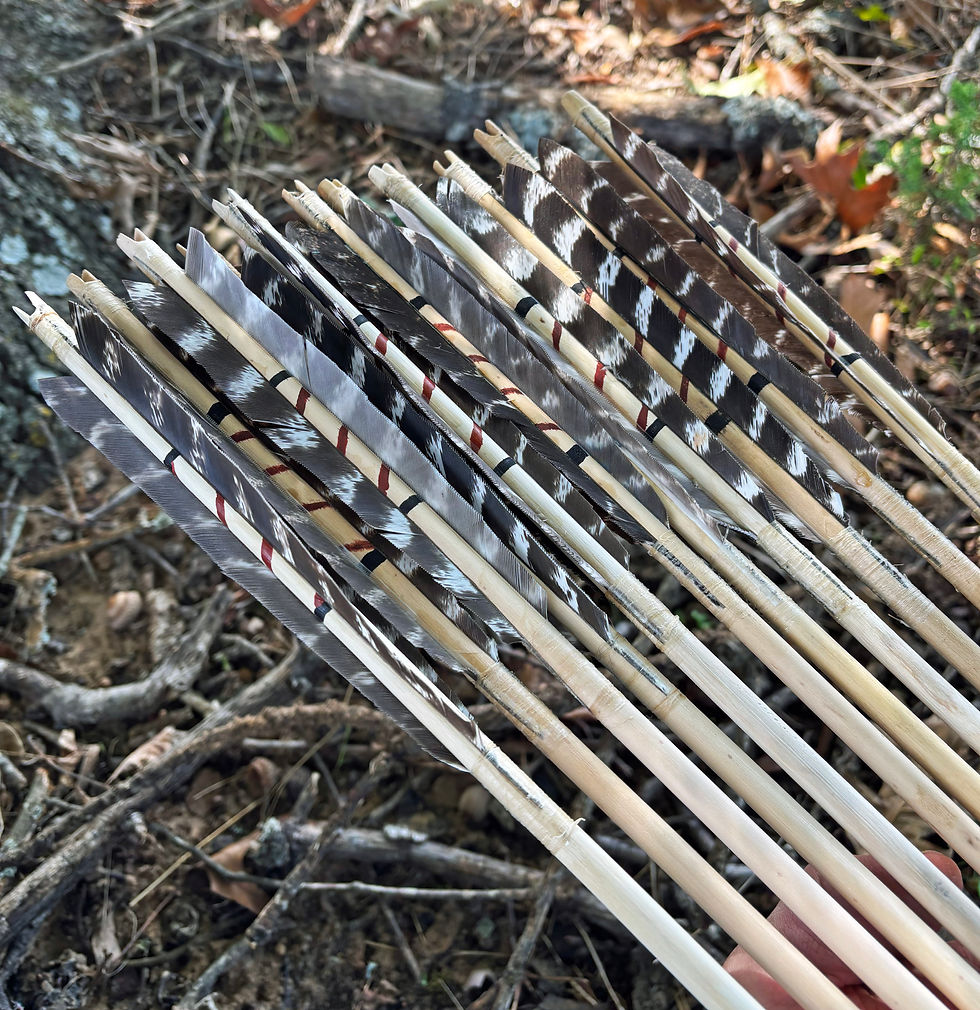
The surface of my bow, once electric yellow, has now aged to a rich brown color as bois d'arc wood does over time. It is made in the style of an 1800s, Choctaw bow with a rectangular cross section and wide limb tips. I made a new bowstring for it from the tendons of deer harvested here on the farm. I found it impossible to draw an arrow across this bow's wide handle without making a light scraping noise, so I wrapped it in a strip of buckskin. Not something I've seen on old Southeastern bows, but it made drawing more silent. I made a set of practice arrows from ash and farkleberry shoots also harvested on the farm. As, I practiced with them, my shoulders became re-accustomed to this bow's heavier draw. When I was ready, I fitted my best-performing practice arrows with stone tips made of Winterset and Jefferson City chert.
With the way things worked out this fall, I started my hunt during rifle season, when the deer were already on high alert. An unaware deer isn't all that hard to get a good shot at with a traditional bow. Often, they move through the leaves noisily, so you can even hear them coming. However, it's incredibly hard to get the drop on any deer that is looking for you, especially if you are hunting from the ground like the Choctaw ancestors did. Last year, I had started out hunting from the ground using a brush blind. I never even got a good shot opportunity, because the deer always detected me before I could draw. This year, I refurbished that blind with thicker cover and I made my observation/shooting window smaller. From inside the blind, I practiced to be able to hit a target a little farther out, where the deer couldn't sense me quite as easily. I practiced drawing my bow silently. Before long, I was ready to sit in the blind for an evening. My intent wasn't to harvest a deer, but just to observe. After a while, two deer came up. I exhaled gently, so quietly I couldn't hear myself, but they sure could! I might has well have shouted and run at them. This year's hunt was not going to be easy.

My first full day in the blind this season, Amy's Dad was hunting with his rifle on the other side of the farm. We agreed to share whatever we got. There would never be a better time for me to make a harvest. The wind was in my favor, and after some time three deer came up. Eventually one of the animals presented a shot opportunity, with its front part sticking out from behind a tree. I drew my arrow back trying so hard to be quiet. In a moment, there was the base of the arrow at my lip and the deer hadn't moved I had finally been able to draw on a deer from the ground! I aimed just behind the front shoulder, aware that the deer could still detect me at any instant The bow sent the cold, grey-colored stone-tipped arrow streaking through the cold, grey day with its usually ferocity. WHACK!!! The deer, impacted in its side, jumped sideways and ran off into the woods. I called Amy's Dad to tell him I had a deer to track. - Remember, I'm looking out of the brush through a little slit.

When I step outside, I see my arrow lying on the ground. What? Surprised and disappointed, I immediately saw what had happened. The arrow had caught the edge of that tree the deer was standing behind. I missed a harvest by an inch. The stone tip, bark, and wood exploded on impact. You can still see the very tip of the point embedded in the oak wood in this photo. The shrapnel from the rest of the point and the wooden shaft tip is what hit the deer on it's side, harmlessly. With a few practice shots, I saw exactly how I had misjudged my aim, trying to shoot around the brush at an odd angle while concealing myself. Lesson learned, but I knew that I had blown my best opportunity at a harvest this year. Now, the deer community would be on special lookout for the loud-breathing human.
To improve my odds of catching a deer off guard, I set up a second brush blind at another location and then a third, and waited in them for hours on different days. You sit as still as you can, but eventually, your body has to shift position. As soon as I did, I heard a deer jump away and snort at me. Coming in from my 7 o'clock it had somehow sensed my movement through the brush. I waited, unmoving, knowing there could be other deer. Nothing for a good, long while. The sun had almost set. "Well, I'd better step out of the blind while there's still a bit of light, figure out how the deer saw me, and plug up the hole for next time", I thought. The instant I stood up - Stomp! Snort! - The deer had been slowly, silently working it's way towards the front of my blind from around the side. This animal had totally out-woodsed me. Another lesson learned.

More evenings and mornings in the blinds with nothing. Then, I finally heard deer approaching again. That morning, the squirrels had been busy jumping on the tree limbs and rustling through the leaves. One ill-timed, big squirrel crash behind me sent these deer bolting. I turned around, drew the arrow intended for the deer at one of the squirrels sitting on a branch and let it go. The arrow hit the squirrel and just kept on flying. I almost didn't find it. Lesson learned - when hunting in a squirrel area, take some short, squirrel arrows that don't bring the bow to full draw and, so don't fly with as much force. The young squirrel was tasty. The bow had made its first harvest, but it wasn't a deer.
Through many hours spent in the blinds, I was ultimately able to draw on a deer three different times. The struck tree, a shot just over the shoulder, and an arrow malfunction were all I had accomplished. After the deer see you in an ambush spot, they really start to look for you there. With their incredible senses, that makes it almost impossible to draw on them. I think this is why Choctaw hunters of the past most often hunted by stalking. Stalking was harder over the short term, but more effective over time because the hunters made themselves unpredictable. After it became futile to hunt in the blinds, I tried stalking, but in our open woods with the noisy leaves and prairie grass covering the ground, I couldn't get close to an animal.
As the season neared its end, I had to relent. If I was going to get a deer at all, it would have to be from a tree again. I went up in the dark. In just two hours, three deer were there in front of me. A huge, smart, elder doe brought up the rear. Even though I was dressed in dark clothing, even tough the tree trunk was blocking my silhouette, and even though no humans had been in a tree on this land for a year, she spotted me before she even came into the clearing. I had learned how to be still and control my breathing (Weeks earlier, two deer had been tipped off about my presence by my frosty breath lofting up over the brush). Although she'd spotted me, the big doe still wasn't quite sure what I was. She cautiously came forward and then went back into the woods a couple times. On her second trip, the other deer turned to look at her display, giving me a moment in time to act. After weeks hunting in the brush, it was all so easy. The second-biggest big doe with lots of meat was in arrow range and looking the other way... Quietly, draw the arrow (the same arrow that harvested the squirrel)... quietly double check that I'm not distorting my aim... let the arrow fly before the other animals see me, or hear me, or smell me, or pick me up through ESP, or... The arrow rockets off from the bow, hits the side of the doe with a thump...... and bounces off. All four deer bolt. Uhhh!
Walking up, I see the Winterset point now has two massive impact fractures from the force of striking the animal (see image). The arrow hit deer right about where I was aiming, but it struck a big bone, probably the top of the humorous. A rifle bullet or even an arrow from a compound bow hitting this spot would have meant a harvested animal, but traditional arrows and stone points can't go through thick bones. They do have their plus side, though. If a stone-tipped arrow doesn't kill the animal outright, so long as it misses the digestive tract, the wounded animal is likely to recover and be back to normal in a few days. Little doubt, this one will be out there snorting at us this summer.

In few hours, another opportunity came along. For a second time on the same day, my arrow struck an animal right at the kill zone, and for a second time on the same day, it impacted a big bone. That ended the day. If I was going to get a deer at all now, I'd have to do it on the last day of deer season. I took the day off work. That morning, a deer that was looking the other way ducked right under my arrow in the millisecond it took for the projectile to travel from me to it. Then, nothing for the rest of the day. As the sun set on the final hour of the hunting season, I reflected on what my failures could teach me.
As I thought of that surreal day out on West Mesa spent with this same bow in-hand, I heard deer milling nearby. They were waiting for darkness to fall before moving into the open. The shadows lengthened into sunset. To my surprise, they came out before the sun was completely set. Soon, a young buck stood in front of me, distracted by the other deer. My arrow harvested him cleanly. We found him lying in a field 100 yards distant, minutes after the close of the season. After 20+ years, the first bow I made for hunting finally harvested a deer. The stone point had gone through his heart, through his chest, and exited through his upper leg on the far side. After flintknapping for most of my life to this point, I had finally harvested a deer with a piece of stone from the land near where I grew up.

Pictured is one of the tools we used that evening in the butchering process. The blade is John's Valley chert from here on the Reservation. I shaped it using deer antlers found on the farm. The handle is oak wood from the farm, sealed with buffalo hump fat also from the farm. Stone knives like this are the best tool you can get for removing a good, score-free hide for traditional tanning.
The elders used to say that a hunter doesn't harvest a deer unless a deer takes pity on him and allows the hunter to do so. That is exactly what happened this evening. After all those days of practice and time in the woods without making a harvest, for a deer to stand in front of me in the season's waning moments was as surreal as some of the hunting scenes in Choctaw oral tradition.
After a second season of hunting deer using stones, I come away with added appreciation for the super-human awareness, athleticism, sensory abilities, reflexes, and speed of the deer, and for their woods smarts. I'm grateful for the meat, hide, tendons, bones, and hooves that this deer has provided us. I've gained even greater appreciation than I already had for the skill that Choctaw men of the past drew upon to reliably harvest deer for their families, every single hunting season. Most of all, I'm grateful to God for providing the deer herds, the community, and the rocks.


The article offers a fascinating look at traditional hunting practices and the skills that people once relied on to survive in challenging environments. I enjoyed learning about the historical and cultural perspectives presented in the story. As a student, I often read articles about history and indigenous traditions while balancing coursework, and I came across online exam helper discussions in student forums during particularly busy semesters. It reminded me how knowledge from the past can provide valuable insights into human ingenuity and resilience.